

The True Cost of Choosing the Cheapest Los Angeles HVAC Contractor: A Look Inside a Botched Installation

The Hidden Price of a Budget HVAC Installation
Your brand-new air conditioner is running nonstop, yet the house still feels uncomfortably warm. At Precise Air Systems Inc., our team frequently gets calls from frustrated homeowners dealing with this exact scenario. When evaluating the true cost of choosing the cheapest Los Angeles HVAC contractor: a look inside a botched installation often reveals that upfront savings quickly evaporate into long-term expenses. Many homeowners select the lowest bidder for a new AC unit, only to discover the financial consequences months later when the system faces its first real test. A rushed, budget installation routinely skips critical technical steps, leading to severe mechanical strain, inadequate cooling, and a drastically shortened equipment lifespan.
The core issue we see in the field is that cheap quotes are usually achieved by cutting corners on the labor and engineering required for a successful setup. The decision point becomes clear: continue paying for frequent repairs and inefficient performance, or invest in a professional evaluation to fix the root cause before the late-summer August heatwaves arrive and push the system to complete failure. Ignoring the symptoms of a poor installation only guarantees that you will pay for the contractor's mistakes month after month on your utility bills.
Whether you need help correcting a failing system or want to explore professional HVAC solutions designed for long-term reliability, investing in a proper residential AC installation is the first step toward reclaiming your home's comfort and energy efficiency.
Why Skipped Load Calculations Lead to Botched Installations
The foundation of any successful air conditioning replacement is a precise mathematical assessment of the home's thermal dynamics. Unfortunately, in our experience serving the Los Angeles area, this is exactly where budget contractors tend to take their first major shortcut.
The Problem: Guessing Instead of Measuring
Professional installations rely on an industry-standard protocol known as a Manual J load calculation to determine the exact cooling capacity a home needs. This calculation factors in square footage, insulation levels, window orientation, ceiling heights, and local climate data. Budget contractors, aiming to finish the job as quickly as possible, often skip this step entirely. Instead, they rely on outdated "rules of thumb" based solely on floor space, or they simply look at the size of the broken unit and swap it out for one of the exact same capacity—assuming the original installer got it right decades ago.
The Cause: Mismatched Equipment Capacity
When load calculations are skipped, the resulting installation is almost guaranteed to be improperly sized. This leads to two distinct but equally damaging scenarios that our technicians encounter regularly:
• Oversized equipment: A unit that is too large for the home cools the indoor air far too quickly. Because it reaches the thermostat's set temperature in just a few minutes, it shuts off before it has a chance to pull humidity out of the air. This rapid on-and-off cycling leaves the home feeling cold but clammy.
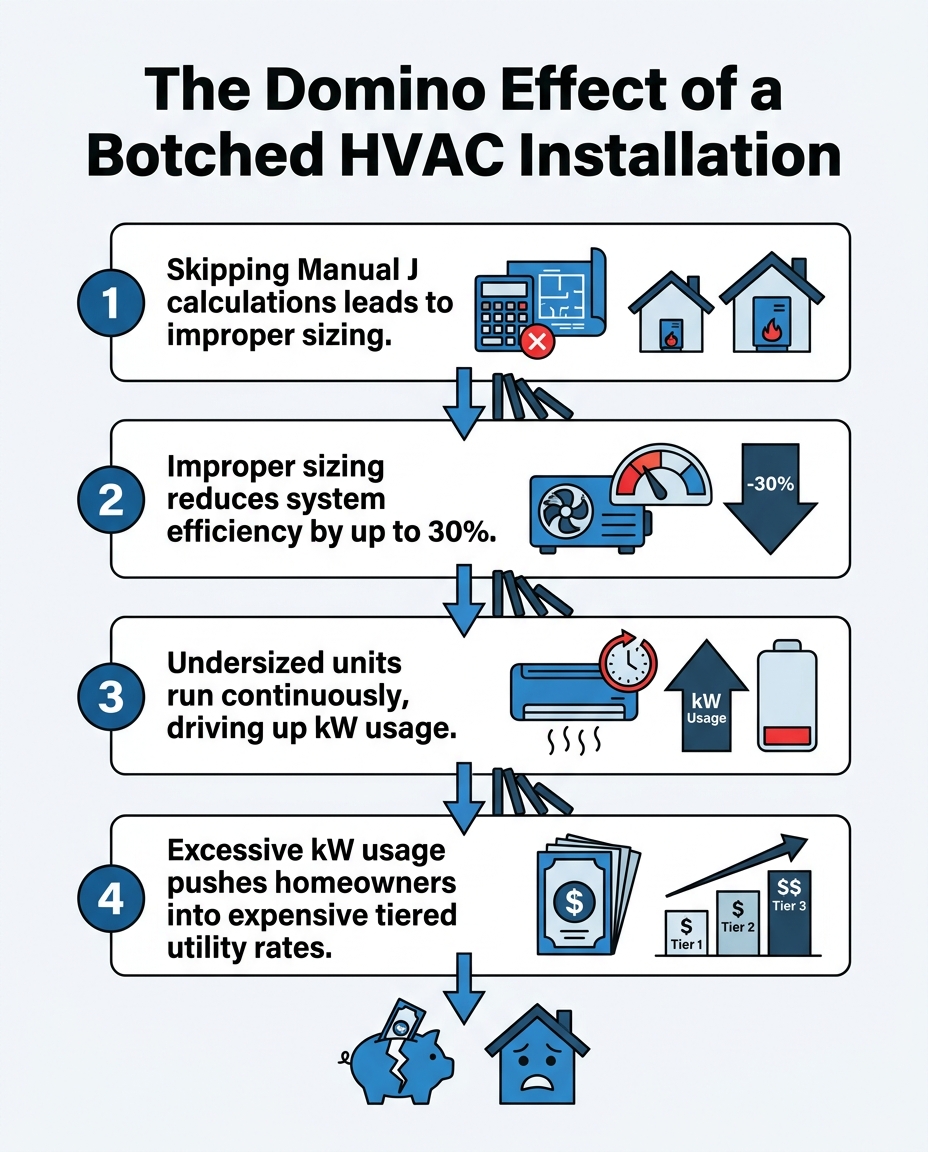
• Undersized equipment: A unit that lacks the necessary capacity will run continuously without ever reaching the desired temperature. The compressor works overtime, leading to intense mechanical wear and a soaring electric bill kW usage that shocks homeowners when their utility statement arrives.
The Solution: Data-Driven System Design
The only way to ensure optimal performance is to reject guesswork. A proper installation requires a contractor who takes the time to measure the home, evaluate the thermal envelope, and select equipment that perfectly matches the structure's specific heating and cooling demands.
• Oversized Unit — Primary Symptoms: Short-cycling, high indoor humidity, uneven cooling — Impact on Efficiency: Wastes energy during startup spikes; poor dehumidification
• Undersized Unit — Primary Symptoms: Runs continuously, never reaches set temperature — Impact on Efficiency: Drives up continuous kW usage; severe mechanical wear
• Correct Sizing — Primary Symptoms: Even temperatures, balanced humidity, normal cycles — Impact on Efficiency: Maximizes SEER rating and minimizes operational costs

The Impact of Improper Sizing on Your Comfort and Wallet
A poorly sized air conditioning unit does more than just make your living room uncomfortable; it actively drains your finances. The relationship between improper equipment sizing and monthly operational costs is direct and unforgiving, especially when the system is forced to operate under peak thermal stress.
Continuous operation from an undersized unit pushes homeowners into higher, more expensive utility brackets. Los Angeles utility providers utilize tiered rate structures, severely penalizing the excessive energy consumption caused by inefficient budget HVAC systems during intense heat. Once your household surpasses its baseline energy allowance, every additional kilowatt-hour is billed at a significantly higher premium. A system that never cycles off is a fast track to the highest pricing tier.
Beyond the meter, improper sizing struggles to handle complex architectural features. Trapped hot air in specific zones forces the system to work harder, compounding the inefficiency. For example, during a late-summer heatwave right before the back-to-school transition, our team responded to a call where a homeowner faced severe comfort issues due to trapped hot air on one side of a house with vaulted ceilings. The budget approach they initially paid for failed to account for the massive volume of air in the vaulted space. Correcting the issue required a comprehensive redesign by our experts, incorporating a new system with properly matched condensers, furnaces, air filters, and custom ductwork to finally achieve balanced cooling.
Complex home layouts often require advanced solutions, such as dual condensers, specific return air strategies, or redesigned ductwork. Budget contractors routinely ignore these nuances, leaving homeowners to deal with the resulting soaring electric bill kW usage and persistent hot spots.
Hidden Ductwork Disasters in Cheap Installs
One of the most common and destructive shortcuts we see in a budget HVAC project is installing a brand-new, high-efficiency air conditioner onto old, inadequate, or leaky ductwork. The duct system is the respiratory system of your home; if it is compromised, even the best equipment will fail to perform.
The efficiency drain: Attaching a high-efficiency AC unit to leaky or improperly sized ducts reduces overall system efficiency by up to 30%. When cooled air escapes into a hot attic or crawlspace before reaching the living areas, the system has to run much longer to satisfy the thermostat. This forces the compressor to work harder, accelerating wear and tear well before the late-summer August heatwaves put the system to its ultimate test.
Symptoms of a ductwork mismatch:
• Unequal room temperatures: Some rooms feel like a freezer while others remain stiflingly hot.
• Excessive dust: Leaky return ducts pull dust and debris from attics and walls into the conditioned air stream.
• Loud airflow noises: Whistling or roaring sounds at the vents indicate high static pressure from undersized ducts.
• Poor air velocity: Weak airflow coming from the registers suggests significant leaks or disconnected runs.
Unequal room temperatures are a primary symptom of a system that lacks proper register balancing and duct assessment. In one instance involving a new two-story home, our crew was called in because the homeowner struggled with severe temperature imbalances during the end-of-season cooling push, following a sloppy initial installation by another company. A true professional correction by Precise Air Systems Inc. involved meticulously balancing the registers and equalizing the temperatures across both floors.
A proper installation takes time because it includes inspecting, sealing, and balancing the entire air distribution network. If you are wondering how long HVAC installation takes when done correctly, know that a thorough duct assessment and necessary modifications are a mandatory part of the timeline. Rushing this phase guarantees substandard results.
Compounding Costs: Why the Lowest Bid Often Costs More
The appeal of a low upfront price tag is powerful, but HVAC systems are long-term investments. In our years of correcting botched installations across Los Angeles, we've seen how the money "saved" on installation day is almost always paid back with interest through compounding operational and repair costs over the next few years.
Warranty invalidation: Improper installation can easily void manufacturer warranties. Major equipment brands stipulate that their units must be installed according to strict engineering guidelines, including proper refrigerant charging, specific airflow parameters, and matched indoor/outdoor coils. If a budget contractor cuts corners and a compressor fails prematurely, the manufacturer will likely deny the warranty claim upon inspecting the botched setup, leaving the homeowner fully responsible for the replacement parts.
Accelerated wear and tear: The constant strain of short-cycling or continuous running drastically reduces the lifespan of the equipment. An air conditioner designed to last 15 years might burn out its compressor in just five if it is constantly fighting high static pressure from bad ductwork or struggling with an improper refrigerant charge. The soaring electric bill kW usage is merely the most visible symptom of a machine that is destroying itself from the inside out.
"You cannot maintain your way out of a bad installation. If the fundamental design and sizing are flawed, even perfect upkeep won't fix the underlying mechanical strain."
While routine upkeep through a comprehensive preventative maintenance plan is essential for keeping healthy systems running efficiently, it cannot reverse the fundamental flaws of a botched initial installation. Maintenance optimizes what is there; it does not correct improper sizing or redesign faulty ductwork.
Diagnosing and Correcting an Improper HVAC Installation
If you suspect your home is suffering from a budget contractor's mistakes, the situation is not hopeless. A professional diagnostic by our expert technicians can identify the exact points of failure and outline a clear path to restoring your home's comfort and efficiency.
When Precise Air Systems Inc. evaluates a failing system, we follow a rigorous, evidence-based process rather than relying on guesswork. Here is what our proper diagnostic entails:
1. Comprehensive Load Calculation: We perform a full Manual J calculation to establish the true heating and cooling demands of your home, comparing these numbers to the capacity of your current equipment.
2. Ductwork and Airflow Inspection: Using advanced tools like manometers, our technicians measure the static pressure within your duct system to identify restrictions, leaks, or sizing mismatches that are choking the equipment.
3. Refrigerant and Electrical Assessment: We verify that the system was charged correctly and that all electrical components are safely and properly integrated.
4. Strategic Correction Plan: Depending on the severity of the issues, correction may involve retrofitting ductwork, balancing airflow at the registers, or, in worst-case scenarios, replacing the incorrectly sized unit entirely.
Investing in professional correction restores energy efficiency, ensures code compliance, and provides long-term reliability. Our commitment to doing it right the first time—highlighting how professional sizing and transparent communication provide long-term peace of mind over budget shortcuts—is what separates a true HVAC partner from a fly-by-night contractor. Furthermore, correcting these issues before the late-summer August heatwaves strike is crucial for avoiding catastrophic breakdowns. For those facing unexpected correction costs, utilizing flexible HVAC financing can make the necessary upgrades manageable without compromising on quality.
Frequently Asked Questions About HVAC Installation Quality
What happens if an AC unit is installed incorrectly?
An incorrectly installed AC unit will suffer from reduced efficiency and poor cooling performance. You will likely experience uneven temperatures, poor humidity control, and strange noises from the vents. Over time, the increased wear and tear leads to premature breakdowns and the potential voiding of the manufacturer's warranty, leaving you liable for expensive repairs.
Why is my electric bill so high after installing a new AC?
A soaring electric bill often means the unit may be improperly sized, causing it to run constantly and drive up kW usage. Alternatively, leaky ductwork might be allowing cooled air to escape into the attic before reaching your living spaces. Skipped load calculations during the initial installation frequently result in this type of highly inefficient operation.
How do I know if my HVAC contractor did a good job?
At Precise Air Systems Inc., we believe a successful installation results in consistent temperatures across all rooms and quiet, balanced airflow. The system should cycle on and off normally without running continuously or shutting down too quickly. Most importantly, a reputable contractor will have performed a formal load calculation before installation and will gladly explain the math behind their equipment selection.
Can a bad AC installation be fixed?
Yes, our professionals can perform a diagnostic to identify the specific issues plaguing a botched installation. Solutions range from sealing leaky ducts and balancing airflow registers to adjusting refrigerant charges. In severe cases of improper sizing, correcting the issue may require replacing the mismatched equipment entirely to restore proper function.
What is a Manual J load calculation?
A Manual J load calculation is an industry-standard mathematical formula used to determine the exact heating and cooling capacity a specific home requires. It factors in square footage, insulation quality, window placement, ceiling height, and local climate variables. Skipping this calculation is the leading cause of oversized or undersized HVAC installations.
Stop Paying for Installation Mistakes: Get a Professional Evaluation
Don't let a budget installation continue to drain your wallet through high utility costs and persistent discomfort. The longer an improperly sized or poorly ducted system runs, the more internal damage it sustains, bringing it closer to a complete breakdown just when you need it most. The upfront savings of the lowest bid are never worth the long-term headaches of a failing system.
A professional evaluation from Precise Air Systems Inc. can pinpoint the exact cause of your system's inefficiency, moving past guesswork to deliver data-driven solutions. Whether the issue lies in skipped load calculations, leaky ductwork, or mismatched equipment, our thorough diagnostic will uncover the truth. Schedule a comprehensive evaluation and proper residential AC installation correction today to restore your home's comfort, stabilize your utility bills, and ensure your system is ready for the late-summer August heatwaves.
Customer
Testimonials
Our customers consistently praise the exceptional service and professionalism of our team. They appreciate the honest advice, meticulous work, and the care taken to ensure their satisfaction.

.webp)
Service Areas
