

Why Your Heater Smells Like Burning Dust and How Air Scrubber Service Can Help

That Alarming Burning Smell During the First Fall Heating Cycle
When the nights start getting chilly in October, you finally switch your thermostat from cooling to heating. But instead of comforting warmth, your vents blast an alarming burning smell throughout the house. If you are panicking, you are not alone—getting common homeowner questions answered about this exact issue is a daily occurrence for our team at Precise Air Systems Inc. during the first fall heating cycle in October. That sudden, acrid odor can make you wonder if your furnace is catching fire or if you just need to wait it out.
The quick fix: If you want to stop these seasonal odors and breathe easier, exploring professional indoor air quality services—such as a dedicated air scrubber service—can make a massive difference for your home.
While a brief burning dust smell is a normal part of the seasonal transition, excessive or lingering odors indicate a much larger issue with your indoor air quality. The air circulating through your home is carrying particulate matter that settles directly onto your heating equipment. By understanding exactly what is happening inside your ductwork, you can take the right steps to prevent these alarming smells and protect your family's respiratory health.
Understanding the Causes of Seasonal HVAC Odors
To understand why your heater smells like a dusty campfire, you have to look at what happens to your system during the long, hot months when the heater is turned off. The problem begins long before you ever adjust the thermostat for autumn weather.
The Impact of Summer Dormancy
During the extended summer air conditioning season, the heating elements inside your furnace or heat pump sit completely dormant for six to eight months. Even though the heating components are turned off, the blower motor is still pulling air across them every time the AC runs. This months-long period of inactivity allows a thick layer of microscopic debris to form on the heat exchanger and burner components. If your home lacks proper air filtration, this buildup becomes significantly worse as unfiltered air constantly washes over the idle equipment.
What Exactly Is Burning?
When you initiate the first fall heating cycle in October, the heat exchanger rapidly climbs to high temperatures. The sudden intense heat literally incinerates the layer of debris that has collected since last winter. The odor you smell is the physical process of this settled debris burning off. In most cases, what is burning is a combination of harmless organic matter:
• Household lint: Tiny fibers from clothing, carpets, and upholstery.
• Skin cells and pet dander: The natural microscopic shedding from people and animals inside the home.
• Standard household dust: Dirt and soil particles tracked in from outside.
The severity of the smell is directly tied to how much particulate matter is circulating in your home. A heavily polluted indoor environment will result in a much stronger, longer-lasting odor when the heater finally kicks on.
Normal Dust Burn-Off vs. Urgent Safety Hazards
Knowing the difference between a harmless seasonal nuisance and a dangerous mechanical failure is critical. We always emphasize to our customers the need for an objective, safety-first baseline to help make immediate decisions about your HVAC system without attempting dangerous DIY diagnostics.
The 30-Minute Rule
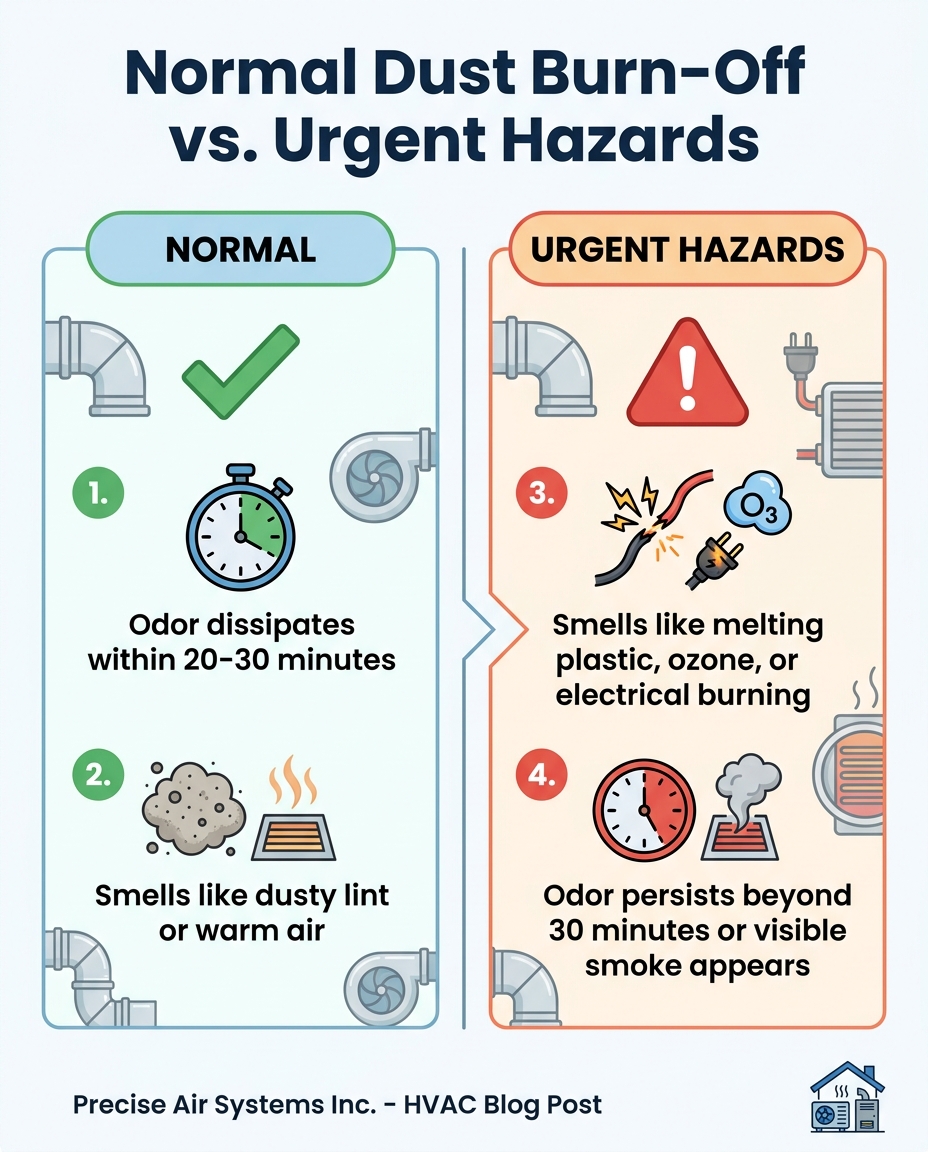
The golden rule for the first heating cycle is that a normal dust burn-off odor dissipates within 20-30 minutes of continuous operation. The smell should peak within the first ten minutes and steadily fade as the heat exchanger cleans itself. Opening a few windows temporarily can help clear this harmless initial smell from your living space. If the odor is strictly related to dust, it will not return during subsequent heating cycles.
Warning Signs of Mechanical Failure
If the smell does not fade, or if it takes on a different chemical profile, you are no longer dealing with dust. Certain odors indicate a severe mechanical or electrical failure that requires you to shut off the system at the thermostat immediately. Physical inspections of the heat exchanger, blower motor, or internal wiring always require a licensed professional.
• Musty, dusty, or singed lint — Likely Cause: Normal seasonal dust accumulation burning off the heat exchanger. — Required Action: Monitor for 20-30 minutes. Open windows to ventilate.
• Melting plastic or rubber — Likely Cause: A foreign object in the ductwork or a failing blower motor belt. — Required Action: Shut off the system immediately and call a professional.
• Electrical burning or ozone — Likely Cause: Overheating blower motor, frayed wiring, or a failing capacitor. — Required Action: Shut off the system immediately at the thermostat.
• Rotten eggs or sulfur — Likely Cause: A natural gas leak near the furnace. — Required Action: Evacuate the home and call the gas company immediately.

How Local Smog and Wildfires Increase Indoor Particulate Load
In our years of serving the Los Angeles area, our technicians have consistently found that the burning dust smell is often much more intense for homes in Southern California than in other parts of the country. This is directly tied to the unique environmental challenges of our region. During the late summer and early fall, urban smog levels frequently rise, elevating the amount of fine particulate matter (PM2.5) in the outdoor air. Because homes are not airtight, this polluted air naturally infiltrates your living spaces.
Furthermore, seasonal wildfires introduce a massive volume of microscopic ash into the environment. Wildfire ash is exceptionally fine—much finer than standard household dust—and highly pervasive. It easily bypasses standard weatherstripping and basic air filters, settling deep inside your HVAC ductwork and directly onto the dormant heating elements.
When the first heating cycle ignites, it isn't just burning off pet dander; it is incinerating months of accumulated urban smog particles and wildfire soot. This heavy outdoor pollution load makes the initial burn-off smell much harsher and underscores the absolute necessity of having robust indoor air quality solutions capable of capturing microscopic environmental contaminants.
Why Standard Filter Replacement Might Not Be Enough
When faced with heavy dust accumulation and poor air circulation, many homeowners assume that simply swapping out their basic 1-inch fiberglass filter will solve the problem. While regular filter replacement is a critical maintenance step, it is often not enough to combat severe particulate loads.
The Limits of Passive Filtration
Standard filters are designed primarily to protect the HVAC equipment from large debris, not to purify the air you breathe. They are a passive defense system—they only catch what directly passes through the return vents. Microscopic wildfire ash, smog particles, and volatile organic compounds (VOCs) easily slip right through the loose weave of a basic filter and continue circulating through your home.
Complex home layouts can make passive filtration even less effective. Our team recently worked with a local homeowner who experienced this firsthand when dealing with vaulted ceilings that trapped hot air on one side of their house, leading to high electricity bills and poor air circulation. To resolve this complicated airflow problem, we designed and installed a comprehensive solution featuring a new HVAC system with two condensers, two furnaces, whole-house air filters, and additional returns. This advanced setup not only balanced the home's temperature but vastly improved the system's ability to filter out airborne contaminants before they could settle.
Severe particulate problems require active purification, not just passive trapping. If your home regularly smells like burning dust in the fall, it means your current filtration strategy is letting too much debris reach the internal components.
What Is an Air Scrubber and How Does It Work?
To truly prevent excessive dust buildup and neutralize airborne contaminants, you need to move beyond standard filters. This is where an active purification device comes in. An air scrubber is an advanced indoor air quality system installed directly into your HVAC ductwork, usually right above the air handler.
Active vs. Passive Purification
Unlike passive filters that wait for air to come to them, scrubbers actively send purifying molecules out into the living space. This active process reduces surface contaminants on countertops and doorknobs, as well as neutralizing airborne particles before they ever reach the return vents.
How Active Purification Works:
1. Integration: A licensed technician installs the unit directly into the supply plenum of your HVAC system, ensuring it works in tandem with the blower motor.
2. UV Light Activation: As air flows past the unit, a specialized broad-spectrum UV light activates a catalytic matrix (typically made of titanium dioxide).
3. Purifying Molecules: This reaction generates safe, highly effective oxidizers—like hydrogen peroxide molecules—that are distributed throughout your entire home via the ductwork.
4. Neutralization: These molecules seek out and break down dust, dander, wildfire ash, and VOCs in the air and on surfaces, causing them to clump together and drop out of the breathing space.
By drastically reducing the amount of dust and ash circulating in the home, an air scrubber service ensures that far less debris settles on your heating elements during the summer, eliminating the severe burning odors in the fall.
Comparing Air Scrubbers to UV Lights and Purifiers
With so many indoor air quality products on the market, it can be difficult to weigh your options and understand which technology best fits your needs. While they all aim to improve your air, they function very differently.
• Whole-Home Air Scrubber — Coverage Area: Entire house (via ductwork) — Primary Function: Actively neutralizes particulates, VOCs, odors, and surface contaminants. — Best Use Case: Homes dealing with heavy dust, wildfire ash, and persistent odors.
• Standalone UV Lights — Coverage Area: Internal HVAC components — Primary Function: Shines directly on the evaporator coil to prevent biological growth and slime. — Best Use Case: Preventing musty "dirty sock" smells and protecting coil efficiency.
• Portable Room Purifiers — Coverage Area: Single room or small zone — Primary Function: Passively filters air through a localized HEPA or carbon filter. — Best Use Case: Targeted relief for a single bedroom or home office.
While standalone UV germicidal lights are fantastic for keeping your indoor coil clean and preventing biological growth, they do not actively seek out dust in the living space. Air scrubbers, on the other hand, address a much wider range of particulates and odors. For the ultimate defense against Los Angeles smog and seasonal dust, we often recommend combining these systems for comprehensive indoor air quality management.
Long-Term Strategies to Improve the Air Quality in Your Home
Preventing the alarming smell of burning dust requires a proactive approach to your home's air quality. Relying on our extensive local expertise at Precise Air Systems Inc. to tailor indoor air quality solutions to the specific environmental challenges of Southern California ensures that your system is prepared for whatever the season brings.
Here are the most effective strategies we recommend to improve the air quality in your home year-round:
• Schedule pre-season maintenance: Having a technician clean the heat exchanger and blower motor before the first heating cycle physically removes the dust before it can burn.
• Invest in professional duct sealing: Leaky ducts in attics or crawlspaces pull in unconditioned, dirty air, bypassing your filters entirely. Sealing them keeps environmental pollutants out.
• Upgrade to high-efficiency media cabinets: Replacing a 1-inch filter slot with a 4-inch or 5-inch media cabinet provides vastly superior passive filtration without restricting vital airflow.
• Request a comprehensive IAQ audit: A professional evaluation can measure your specific particulate load and determine if an active scrubber or upgraded filtration is the best path forward.
By managing your indoor air quality proactively, you protect both your HVAC equipment from premature wear and your family's respiratory health from airborne irritants.
Taking the Next Step for a Healthier Home
Getting common homeowner questions answered by a professional is the best way to ensure your heating system operates safely and efficiently. Remember, while a brief, 20-minute dust burn-off is completely normal during the first fall heating cycle, excessive or lingering odors are a clear sign of poor indoor air quality and excessive particulate buildup.
You do not have to live with poor air circulation, lingering wildfire smoke, or alarming startup smells. By exploring professional indoor air quality services, you can implement integrated purification that keeps your ductwork clean and your air fresh. Reach out to our licensed professionals at Precise Air Systems Inc. to establish clear, objective parameters on what is normal for your system, and take the next step toward breathing easier this season.
Frequently Asked Questions
Why does my heater smell like burning dust when I turn it on?
During the long summer months when your heater is turned off, household dust, pet dander, and airborne debris settle directly onto the dormant heating elements. When you turn the system on for the first time in the fall, the heat exchanger gets extremely hot and incinerates this accumulated debris. This physical burn-off creates the temporary, dry, dusty odor you smell coming from the vents.
How long is it normal for a heater to smell?
A normal dust burn-off odor dissipates within 20-30 minutes of continuous operation. The smell should be strongest right when the system kicks on and steadily fade as the heat exchanger cleans itself. If the smell persists longer than half an hour, or returns on subsequent days, you should have the system inspected.
Is it dangerous if my furnace smells like burning?
It depends entirely on the type of smell and how long it lasts. A brief smell of singed lint or warm dust is harmless and completely normal for the first heating cycle of the year. However, if the odor smells like melting plastic, ozone, or electrical burning, it indicates a dangerous mechanical or electrical failure that requires immediate professional attention.
When should I shut off my HVAC system due to an odor?
You should shut off your HVAC system immediately at the thermostat if you smell melting rubber, electrical burning, or if you see visible smoke coming from the vents. Additionally, if you smell rotten eggs or sulfur, this indicates a natural gas leak; you must evacuate the home and contact your gas provider right away.
Can an air scrubber eliminate wildfire smoke odors from my home?
Yes, whole-home air scrubbers are highly effective at neutralizing the volatile organic compounds (VOCs) and fine particulate matter found in wildfire smoke. By actively sending purifying molecules through your ductwork into the living space, the scrubber breaks down the contaminants that cause lingering smoke odors, vastly improving your indoor air quality.
How often does a whole-home air scrubber need professional service?
Most whole-home air scrubbers require professional maintenance once a year. During this annual service, a technician will typically replace the UV bulb and inspect the catalytic matrix to ensure the system is still generating purifying molecules efficiently. This service is easily bundled with your routine fall HVAC tune-up.
Customer
Testimonials
Our customers consistently praise the exceptional service and professionalism of our team. They appreciate the honest advice, meticulous work, and the care taken to ensure their satisfaction.

.webp)
Service Areas
