

Offsetting Your HVAC Electric Bill: The Reality of Integrating Solar Power Before Winter

The Surprising Electrical Draw of New HVAC Systems
Your new central heat pump is finally installed, running quietly, and keeping your home perfectly comfortable, but that first utility bill arrives and the baseline energy usage has noticeably jumped. Offsetting your HVAC electric bill: the reality of integrating solar power before winter is a pressing decision for many homeowners who recently upgraded their heating and cooling equipment. Transitioning away from older, fossil-fuel-dependent furnaces to modern, highly efficient electric heat pumps fundamentally changes how your home consumes power.
If you are exploring a solar installation in Los Angeles, taking action during the September pre-heating season is a strategic move. However, navigating the transition requires looking past overly optimistic sales pitches. You need a realistic understanding of how much electricity your new system actually draws and what a rooftop solar array can genuinely offset during the shorter days of the year. Here is how this works and why it matters for your home's long-term energy profile.
Understanding Your New Energy Baseline
Most homeowners do not realize that swapping a gas furnace for an electric heat pump completely rewrites their home's energy baseline. A traditional gas furnace uses a relatively small amount of electricity to run the blower motor, relying on natural gas for the actual heat generation. A heat pump, on the other hand, relies entirely on electricity to extract heat from the outside air and transfer it indoors.
While heat pumps are incredibly efficient—often transferring three times more heat energy than the electrical energy they consume—they still represent a significant new electrical load on your breaker panel. This shift makes the fall transition period critical for energy planning. If you only look at your historical summer air conditioning usage to size a new solar array, you will drastically underestimate the power required to keep your home warm from November through March.
Why Heat Pumps Change Your Winter Energy Equation
The problem: You expect your utility bills to drop in the winter because you are no longer running the air conditioner on full blast, yet your new heat pump causes your electrical usage to remain stubbornly high.
The cause: Heat pumps operate by moving thermal energy. In the summer, they pull heat out of your house. In the winter, they reverse the process, pulling ambient heat from the outdoor air and pumping it inside. While Los Angeles enjoys famously mild winters, nighttime temperatures frequently drop into the 40s and 50s. To maintain a comfortable 70 degrees indoors, your heat pump must run consistently throughout the night and early morning—exactly when solar panels are producing zero power.
The solution: Before assuming a massive solar array is the only fix, ensure your home's ductwork and airflow are optimized so the heat pump does not overwork. For example, our team at Precise Air Systems recently worked with a Los Angeles homeowner whose vaulted ceilings trapped hot air, leading to soaring electricity bills. We provided a thorough solution—upgrading ductwork and air filtration—which resolved the root cause of the high energy costs and allowed the HVAC system to run efficiently.
The Shift from Gas to Electric Heating
To truly understand your winter energy equation, you have to look at the mechanical differences between traditional and modern heating systems. The shift from gas to electric changes everything about how you are billed.
• Traditional Gas Furnace — Primary Energy Source: Natural Gas — Winter Electrical Load: Low (Blower motor only) — Solar Offset Potential: Minimal impact on heating costs
• Modern Heat Pump — Primary Energy Source: Electricity — Winter Electrical Load: High (Compressor and blower) — Solar Offset Potential: High (Can offset entire heating load)
• Dual-Fuel System — Primary Energy Source: Electricity + Gas Backup — Winter Electrical Load: Moderate to High — Solar Offset Potential: High during mild weather
This table illustrates why homeowners must account for this new electrical load before assuming a standard solar package will cover everything. If your heat pump is running for six hours every night to combat the chill, that electricity is being pulled directly from the grid unless you have a robust battery storage solution in place.
The Truth About Winter Solar Production
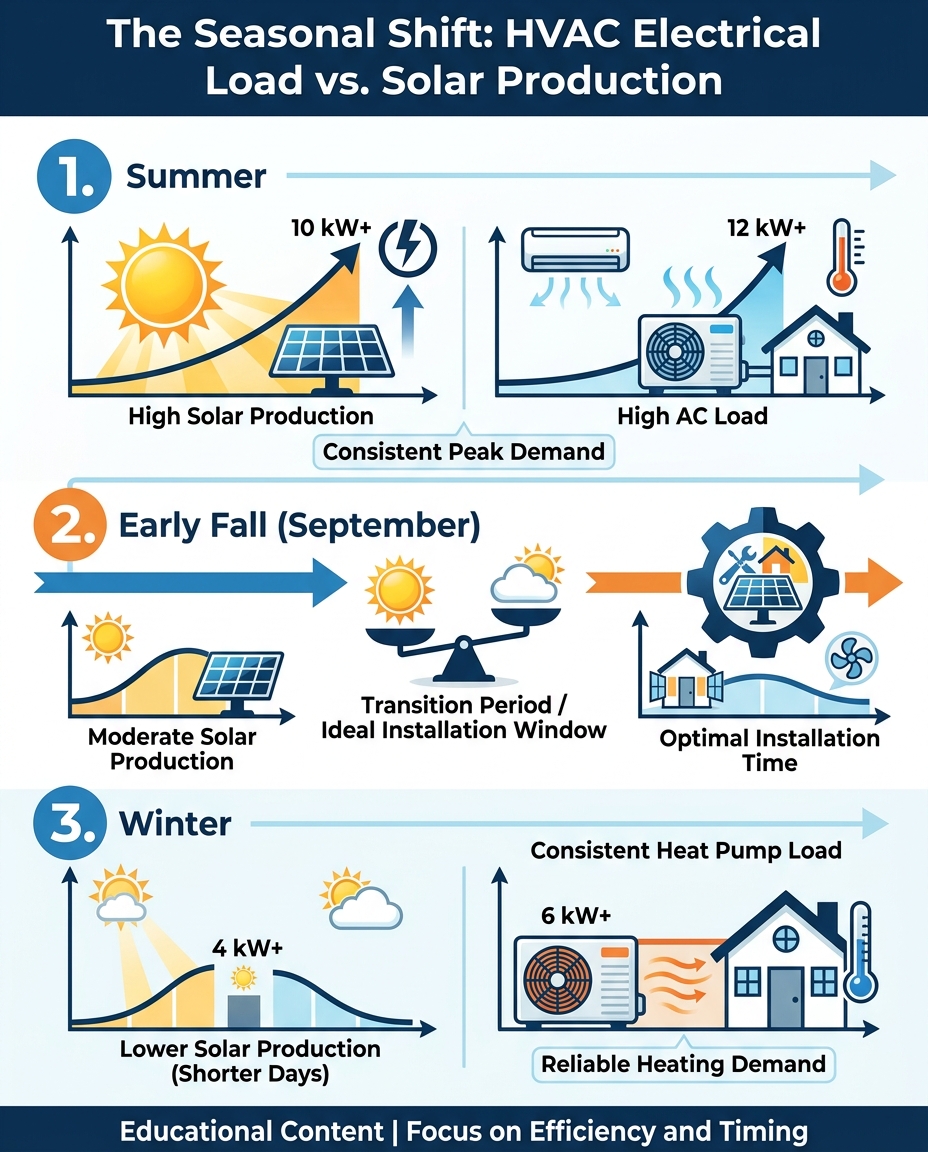
The short answer is that solar panels absolutely work in the winter, but their total daily output drops significantly compared to the summer months. This creates a challenging intersection: your heat pump's electrical demand increases just as your solar array's production capacity decreases. Understanding this seasonal shift is vital for setting realistic expectations.
Los Angeles averages over 280 sunny days annually, making it one of the best climates in the country for solar energy. However, early fall coastal marine layers can temporarily impact morning solar production. When the morning fog rolls in during September and October, your panels will not hit peak generation until the sun burns through the cloud cover later in the day. By the time the marine layer clears, you have already lost several hours of prime generation time.
Shorter Days and Lower Sun Angles
The physics of seasonal solar irradiance dictate that winter generation naturally dips. Here is exactly what happens to your rooftop array as the year progresses:
• Fewer daylight hours: In late June, Los Angeles sees over 14 hours of daylight. By late December, that drops to less than 10 hours. Fewer hours of sunlight mean fewer total kilowatt-hours generated per day.
• Lower sun trajectory: During the winter, the sun sits lower in the southern sky. The angle at which the sunlight hits your panels is less direct, which reduces the efficiency of the photovoltaic cells.
• Increased shading: Because the sun is lower, trees, chimneys, and neighboring rooflines cast longer shadows. A panel that receives full sun in July might be partially shaded by a nearby oak tree in January.
This natural dip coincides precisely with the period when your heat pump begins drawing more power for nighttime heating. A system that overproduces power in July might only cover 60% of your daily usage in December. In our years serving the Los Angeles area, we have found this is exactly why professional sizing and honest evaluations are so important.

Timing the Transition: Why Early Fall Matters
If you want your solar array operational before the winter heating season begins, the timeline is tighter than you might expect. The physical installation of solar panels on your roof only takes a few days, but the administrative and regulatory steps leading up to that moment take weeks. Initiating the process during the September pre-heating season ensures everything is activated before the coldest nights arrive.
While you wait for the solar permitting process to clear, it is the perfect time to explore comprehensive energy efficiency services. Upgrading insulation, sealing leaky ductwork, and installing a smart thermostat can drastically reduce your heat pump's workload, meaning the solar array you eventually install won't have to work as hard to offset your usage.
Navigating the Permitting and Installation Timeline
Here is the realistic, step-by-step timeline you should anticipate when transitioning to solar power in the early fall:
1. Initial assessment and engineering (1-2 weeks): A professional evaluates your new heat pump's electrical load, measures your roof, analyzes shading, and designs a custom array. This step ensures the system is sized for year-round comfort, not just summer cooling.
2. Local permitting and HOA approval (2-4 weeks): Your city's building department must review and approve the engineering plans. If you live in a community with a Homeowners Association, their architectural review committee will also need to sign off. Delays here are common, which is why starting in September is critical.
3. Physical installation (2-3 days): Once permits are in hand, the actual installation of the mounting hardware, panels, and inverters is surprisingly fast. The crew will secure the system to your roof and wire it to your main electrical panel.
4. City inspection and utility interconnection (2-4 weeks): After installation, a city inspector must verify the work meets building codes. Finally, your local utility company must grant "Permission to Operate" (PTO) before you can officially turn the system on and begin generating power.
If you start this four-step process in September, you can realistically expect your system to be generating clean power by November—just in time for the shift to winter heating.
Evaluating the Real Trade-Offs for Your Home
Sizing a solar array is a balancing act. If you size the system based strictly on your historical usage from a gas furnace era, you will end up undersized for your new electric heat pump. If you oversize the system to cover every possible winter scenario, you might generate far more power than you need in the summer, which may not provide a proportional return on your investment depending on current net metering policies.
Last fall, a local homeowner asked our team at Precise Air Systems for quotes on both a new AC system and solar integration. By having our specialists evaluate both sides of the equation, we provided comprehensive recommendations that sized the solar array correctly for the new HVAC load. Getting a combined evaluation for both your heating and cooling equipment alongside your solar needs prevents costly miscalculations.
Sizing Your System for Year-Round Comfort
When professionals calculate the necessary solar offset for year-round HVAC usage, they look at several specific data points:
• The SEER2 and HSPF2 ratings of your heat pump: These efficiency metrics reveal exactly how much power the unit draws to cool and heat your home.
• Your home's square footage and thermal envelope: A drafty house requires the heat pump to run longer, drawing more total electricity.
• Your historical energy bills: Even with a new system, past bills provide a baseline for your family's behavioral energy usage (lights, appliances, electric vehicles).
• Battery storage integration: Because heat pumps run heavily at night when solar panels are dormant, capturing daytime solar production in a home battery system is often the only way to truly offset evening heating costs.
Failing to account for winter heating loads is the most common mistake homeowners make when installing solar. At Precise Air Systems Inc., we always run the math on your specific equipment to show you realistic generation versus consumption curves for December and January.
Navigating Incentives and New System Integration
Integrating a modern heat pump with a rooftop solar array is an excellent long-term strategy, and there are programs designed to encourage this transition. However, navigating the landscape of federal, state, and local incentives requires careful attention to detail. Many programs require specific equipment efficiency ratings or specific installation procedures to qualify.
If you are building a home from the ground up or undertaking a major renovation, planning for both systems simultaneously is highly recommended. Proper HVAC installation for new construction often pre-plans for solar integration, ensuring the electrical panel is sized correctly and the roof penetrations are coordinated smoothly.
Maximizing Available Programs
While specific program details change frequently, here is a checklist of avenues to explore when upgrading your home's energy infrastructure:
• Check federal clean energy tax credits: The federal government often provides tax credits for qualifying solar installations and high-efficiency heat pumps. These credits apply to the equipment and installation costs for your primary residence.
• Explore local utility incentive programs: Many utility providers in the Los Angeles area offer rebates for upgrading from older, inefficient systems to modern heat pumps, as well as incentives for installing battery storage systems.
• Verify equipment eligibility: Not every heat pump or solar component qualifies for these programs. Ensure your chosen equipment meets the specific SEER2, HSPF2, or tier requirements outlined by the incentive programs.
• Consult a certified tax professional: Always verify your eligibility with a qualified tax advisor. An HVAC or solar installer can provide the equipment specifications, but only a tax professional can confirm how these credits will apply to your specific financial situation.
Frequently Asked Questions About HVAC and Solar Integration
Will solar panels offset my heat pump usage in winter?
Yes, solar panels will offset a significant portion of your heat pump usage, but they may not cover 100% of the electrical load during the shortest days of the year. Because heat pumps often run at night when temperatures drop, you are pulling power from the grid unless you have battery storage. A properly sized system will significantly reduce your utility bills, but realistic expectations for December and January are necessary.
Should I install solar before winter begins?
Initiating the installation process during the September pre-heating season is the best strategy. The permitting, installation, and utility interconnection process typically takes several weeks to complete. Starting in early fall ensures your system is fully operational and generating power before the consistent nighttime heating demands of late November and December arrive.
Can solar panels run a central air conditioner effectively?
Solar panels are exceptionally effective at running central air conditioners because peak cooling demand aligns perfectly with peak solar production. During the long, hot days of summer, your panels are generating maximum output at the exact same time your AC unit is working its hardest. This synergy is why solar is so popular in Southern California.
Do solar panels produce enough energy in winter to heat a home?
Solar panels produce less total energy in the winter due to shorter daylight hours and a lower sun angle, which means they generate fewer kilowatt-hours per day. While they still produce reliable power, the reduced output combined with the increased electrical demand of running a heat pump means you may still rely on grid power for a portion of your heating needs during peak winter months.
How do shorter daylight hours affect my HVAC solar offset?
Shorter daylight hours directly reduce the total amount of electricity your panels can generate in a single day. If your heat pump requires 30 kilowatt-hours a day to heat your home, but your panels only receive enough sunlight to generate 20 kilowatt-hours in December, you will have a daily deficit. This seasonal shift must be factored into the initial sizing of your solar array.
Is battery storage necessary when pairing solar with a heat pump?
While not strictly required, battery storage is highly recommended if your goal is to completely offset winter heating costs. Heat pumps do the majority of their work after the sun goes down and temperatures drop. A battery system captures the excess solar power generated during the day and stores it for your heat pump to use throughout the night, minimizing your reliance on utility grid power.
Planning Your Next Steps for a Balanced Energy Profile
Ultimately, offsetting your HVAC electric bill: the reality of integrating solar power before winter comes down to proper planning and realistic expectations. While solar is an excellent way to offset the new electrical loads created by a modern heat pump, understanding the natural dip in winter production is essential. Relying on historical gas furnace data to size a new solar array will leave your system undersized for winter heating demands.
By starting the evaluation process during the September pre-heating season, you give yourself ample time to navigate permitting and interconnection before the cold weather sets in. We encourage you to explore comprehensive solar energy solutions with our team, as we truly understand the nuances of regional climate data and complex HVAC demands. A clear, honest explanation of the trade-offs and actual utility impacts will help you build a balanced, efficient energy profile for your home without relying on exaggerated financial promises.
Customer
Testimonials
Our customers consistently praise the exceptional service and professionalism of our team. They appreciate the honest advice, meticulous work, and the care taken to ensure their satisfaction.

.webp)
Service Areas
