Navigating the First November Heating Startup in the Los Angeles Basin: Normal Smells vs. Warning Signs

The First November Chill: Why Your Heating System Smells Like Burning Dust
When it comes to essential home maintenance tips and troubleshooting for late fall, few things cause more panic than bumping up the thermostat to combat dropping evening temperatures, only to have a harsh burning odor fill the hallway minutes later. You are left wondering if a component is melting, if a filter is catching fire, or if you need to shut everything down immediately. Understanding what happens during that initial seasonal startup is your best defense against unnecessary anxiety as you prepare your home for the holiday season.
During a late fall/November first-chill, your heating equipment is waking up from a very long slumber. The core decision you face in this moment is determining whether that strange, dusty odor is simply harmless burn-off or a legitimate sign of a failing ignition system. Knowing the difference saves you from freezing through the night out of fear, and it also prevents you from ignoring a genuine mechanical hazard. Whether you are managing a residential property or overseeing a facility that relies on heavy-duty commercial AC and heating services, the physical principles governing HVAC systems remain remarkably similar across the board.
The 8-Month Dormancy: How the Regional Climate Affects Your Heater
To understand why that initial burning smell is so potent, you have to look at the unique weather patterns of the Los Angeles basin. In our years of experience at Precise Air Systems Inc., our team typically sees that our Mediterranean climate—characterized by long, intense cooling seasons—causes a unique local issue. Your air conditioner likely runs continuously from April through October to combat the heat. Consequently, your heating components sit entirely dormant for eight to nine months out of the year.
The problem: During those long months of inactivity, your furnace or heat pump is not operating in a vacuum. Even with a high-quality air filter in place, microscopic household dust, pet dander, lint, and airborne particles naturally settle inside the cabinet. They coat the heat exchanger, the burners, and the internal heating elements. In regions with harsher winters, heating systems are only off for a few months, so the dust buildup is minimal. Here, the accumulation is significant.
The cause: The local environment also contributes heavily. Dry summer months, combined with periods of Santa Ana winds, push fine particulate matter into homes and ductwork. Furthermore, shifting weather patterns—such as how rain affects your air conditioning unit during the transition from cooling to heating seasons—can alter indoor humidity levels, causing settled dust to cake slightly onto internal metal surfaces.
The solution: Recognizing this extended dormancy is the first step in troubleshooting. Because the Los Angeles basin climate forces such a long idle period, a dramatic dust burn-off is a completely expected, natural consequence of our regional weather cycle. It is the mechanical equivalent of blowing the dust off a book that has been sitting on a shelf for nearly a year.
The Mechanics of Dust Burn-Off During a Late Fall Startup
When you finally switch your thermostat to "heat" during that late fall/November first-chill, a specific sequence of operations begins inside your furnace. The thermostat sends a signal to the control board, which activates the inducer motor to clear out combustion gases. Next, the ignitor glows hot, the gas valve opens, and the burners ignite. Within seconds, the metal heat exchanger reaches hundreds of degrees.
Any dust, lint, or dander that has settled on that heat exchanger over the past eight months is instantly incinerated. This process produces a distinct, dry, burning smell that gets pushed directly into your ductwork and out of your vents. To help you navigate this event without panic, here is a checklist of what a normal startup looks and smells like:
• A dry, dusty odor: The smell should resemble scorched dust or singed hair, not melting plastic or an electrical fire.
• Smoke-free operation: While you might smell the burn-off, you should never see visible smoke coming from your vents.
• Normal operating sounds: You should hear the standard click of the gas valve and the steady hum of the blower motor, without any loud banging, grinding, or rapid clicking.
• Steady airflow: Once the blower engages, the volume of air coming from your registers should feel consistent with your summer air conditioning airflow.
The 30-Minute Rule for Burning Odors
The most important metric for normal dust burn-off is time. A harmless burn-off odor should dissipate within 15 to 30 minutes of continuous operation. As the heat exchanger reaches its maximum temperature, it rapidly incinerates the thin layer of debris. Once that debris is gone, the smell will fade completely. If the odor is bothersome, the best course of action is to temporarily open a few windows to ventilate the house while the system runs through its first complete heating cycle.
Initial Cold Air Circulation
Another common symptom that causes concern is a blast of cold air when the system first kicks on. This is a mechanical necessity, not a malfunction. When your heater turns on, the heat exchanger needs a few moments to reach the proper temperature. Once it is hot enough, the blower motor activates. However, the ductwork running through your attic or crawlspace is still filled with ambient cold air. The blower must push all of that resting cold air out of the ducts and into your rooms before the newly heated air can reach the vents. This process usually takes two to five minutes.
Diagnosing the Difference: Normal Odors vs. Ignition System Failure
While a burning dust smell is standard for the Los Angeles basin, your heating system can develop actual mechanical faults that require immediate attention. The key to safe troubleshooting is knowing exactly where the boundary lies between a harmless nuisance and a dangerous warning sign.
The problem: You turn on the heater, but the symptoms do not align with the standard 30-minute dust burn-off. Perhaps the smell is sharply chemical, or the air coming from the vents remains frigid long after the system has been running.
The cause: Heating systems rely on complex electrical and gas-delivery components. If a blower motor is seizing up, it can overheat, producing an acrid, electrical burning smell. If a wire's insulation is failing, you will notice a distinct melting plastic odor. If the system continuously blows cold air for more than 10 to 15 minutes, it usually indicates a failure in the ignition sequence. The thermostat is demanding heat, and the blower is running, but the burners have failed to light. This is frequently caused by a dirty flame sensor, a faulty hot surface ignitor, or a tripped safety limit switch.
The solution: Compare your system's behavior against these critical warning signs. If your experience matches the symptoms of component failure rather than simple dust burn-off, it is time to stop the system and call a professional.
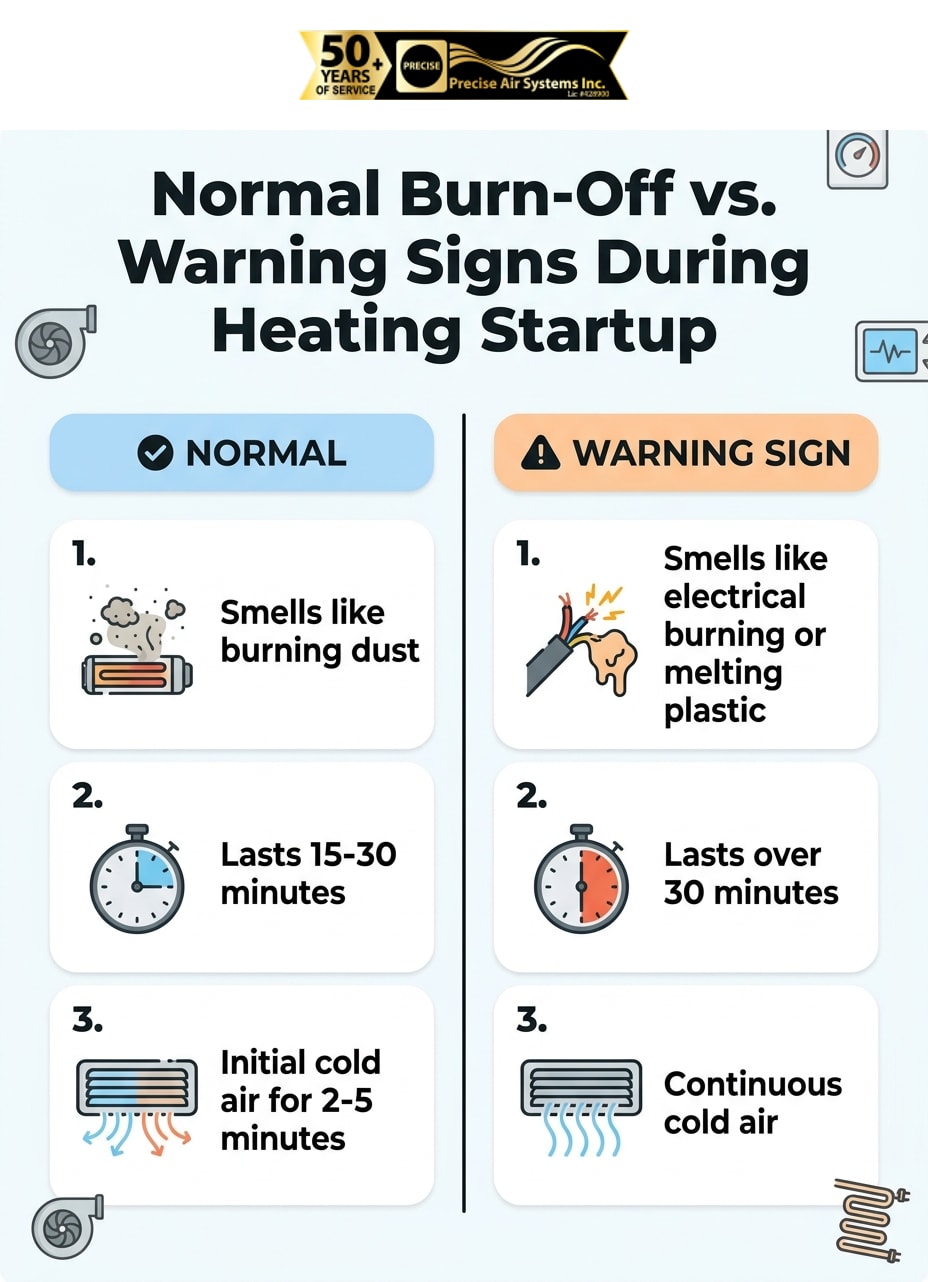
• Type of Odor — Normal Dust Burn-Off: Dry, dusty, slightly singed hair — Warning Sign of Failure: Acrid electrical, melting plastic, metallic
• Duration of Odor — Normal Dust Burn-Off: Fades within 15 to 30 minutes — Warning Sign of Failure: Persists or worsens beyond 30 minutes
• Air Temperature — Normal Dust Burn-Off: Cold for 2-5 minutes, then consistently hot — Warning Sign of Failure: Continuously cold air blowing indefinitely
• Visual Signs — Normal Dust Burn-Off: No visible smoke or soot — Warning Sign of Failure: Visible smoke from vents or soot around cabinet
• System Sounds — Normal Dust Burn-Off: Standard hum and smooth airflow — Warning Sign of Failure: Rapid clicking, heavy banging, or loud grinding
When to Shut the System Down
Never ignore red flags. If you smell electrical burning, smell rotten eggs (which indicates a natural gas leak), hear loud sparking sounds, or see any smoke, walk over to your thermostat and switch the system to "Off" immediately. Ignoring persistent warning signs can lead to severe mechanical damage, cracked heat exchangers, or significant safety hazards for your household.
Safety First: Why Internal Furnace Adjustments Are Not a DIY Project
When faced with a heater that is blowing cold air during a late fall/November first-chill, it can be tempting to search for a quick internet fix. While basic upkeep like changing an air filter, checking a thermostat battery, or ensuring your vents are open are perfectly safe tasks, opening the furnace cabinet to clean sensors or adjust ignition modules crosses a dangerous line.
Modern heating systems are complex pieces of machinery that utilize high-voltage electrical components and combustible natural gas. The sequence of operations is governed by sensitive control boards and safety switches designed to prevent catastrophic failures like gas leaks, carbon monoxide exposure, or flame rollouts. Attempting to bypass a pressure switch or scrub a hot surface ignitor without proper training puts your property and your life at risk.
Furthermore, unauthorized DIY repairs can instantly void your manufacturer warranties and violate local building safety codes. This is where our specialized mechanical engineering expertise at Precise Air Systems Inc. makes a critical difference. A licensed technician possesses the diagnostic tools and the deep understanding of airflow dynamics, electrical resistance, and combustion chemistry necessary to identify the root cause of a failure safely. When a system malfunctions, relying on professional mechanical engineering expertise ensures that the repair is done correctly the first time, restoring your heat without compromising your safety.
Scaling Up: Extending Maintenance Principles to Larger Properties
Many homeowners in the Los Angeles basin also manage commercial spaces, retail storefronts, or office buildings. It is important to recognize that these larger properties face identical, albeit scaled-up, seasonal startup challenges. A commercial rooftop unit (RTU) sitting idle through the summer gathers just as much dust—if not more, given its exposure to the elements—as a residential split system.
Proper maintenance and timely troubleshooting directly impact operational costs and energy efficiency services for businesses. When a commercial heating system struggles to ignite or suffers from clogged burners, it draws excessive amperage and burns fuel inefficiently. This drives up utility overhead and places unnecessary wear and tear on expensive blower motors and heat exchangers.
Complex facilities require specialized attention. From multi-zone setups to heavy-duty commercial HVAC installations, commercial equipment must handle massive air volumes while remaining compliant with strict indoor air quality and safety regulations. If you manage a commercial property, the principles of the first startup apply just as heavily. We strongly encourage facility managers to schedule professional seasonal inspections before the winter weather fully sets in, ensuring that both staff and customers remain comfortable and safe.
Frequently Asked Questions About Seasonal Heating Troubleshooting
Why does my heater smell like burning dust?
Dust, lint, and airborne particles settle on your furnace's internal heating elements and heat exchanger over the long summer months. When you turn the heater on for the first time in late fall/November first-chill, the system reaches high temperatures and incinerates this settled debris, producing a noticeable burning dust odor.
How long should a heater smell when first turned on?
A normal dust burn-off smell should completely dissipate within 15 to 30 minutes of continuous operation. As the heat exchanger burns away the thin layer of accumulated dust, the odor will steadily fade. If the smell persists past this window, it warrants further investigation.
Is it normal for a furnace to blow cold air at first?
Yes, it is entirely normal for the first two to five minutes. The blower motor must push the ambient cold air out of your ductwork before the newly heated air from the furnace can reach your living spaces. Once the ducts warm up, the airflow will turn hot.
When should I call a professional for furnace smells?
You should call a licensed technician immediately if the smell resembles melting plastic, electrical ozone, or rotten eggs, or if a dusty smell lasts longer than 30 minutes. These odors indicate overheating components, failing wiring, or gas issues that require professional diagnostics.
Can a dirty air filter cause my heater to smell?
Yes, a severely clogged air filter restricts airflow, causing the furnace to run hotter than it should as it struggles to pull in air. This excessive heat can singe the trapped dust in the filter and the surrounding cabinet, contributing to a burning smell and potentially triggering a safety shutdown.
Ensuring a Safe, Warm Winter Across the Local Area
Experiencing a brief burning dust smell is a normal rite of passage for the first seasonal startup in the Los Angeles basin. By understanding the mechanics of your system and the impact of our long, dry summers, you can confidently navigate that initial startup without unnecessary worry. However, if you encounter persistent odors, electrical smells, or continuous cold air, those are clear signals that your equipment needs professional attention.
Do not let a malfunctioning ignition system leave you shivering on a cold night. If your system is exhibiting warning signs, reach out to a local expert for a safe, professional inspection. Proper diagnostics and timely repairs are the cornerstone of effective home maintenance tips and troubleshooting, ensuring your home remains reliably warm and safe all winter long.
Customer
Testimonials
Our customers consistently praise the exceptional service and professionalism of our team. They appreciate the honest advice, meticulous work, and the care taken to ensure their satisfaction.


Service Areas