

The Real Cost of Ignoring a Failing AC Capacitor During a Los Angeles Heatwave

Are You Risking Your Entire AC System Over a Minor Electrical Part?
Is your air conditioner humming loudly but failing to blow cold air, leaving you sweating out the real cost of ignoring a failing AC capacitor during a Los Angeles heatwave? A typical pattern we see across Los Angeles CA is a homeowner noticing the early warning signs of a struggling cooling system—a strange stutter on startup, a buzzing noise from the outdoor condenser, or vents that blow stubbornly warm air. The immediate reaction is often hesitation. Worried about potential repair bills, many homeowners decide to wait it out, hoping the system will eventually catch up and cool the house down.
Here is the reality of that decision: delaying a minor electrical replacement means you are directly risking the most expensive mechanical component in your entire system. What begins as a relatively simple electrical deficit quickly turns into a catastrophic mechanical failure when extreme summer temperatures are involved. The choice is rarely between fixing it now or fixing it later; it is usually between replacing a small cylindrical part today or replacing an entire compressor next week. If you need professional air conditioning services, getting an expert assessment now can save your system from irreversible damage.
Understanding the Vital Role of Your AC Capacitor
To understand why delaying this repair is so dangerous, you first have to understand what this component actually does. Residential air conditioning systems run on single-phase electrical power. While this is perfectly fine for running your household appliances, single-phase power does not naturally create the rotating magnetic field required to start a heavy-duty motor like your AC compressor. The capacitor solves this problem. It acts as a massive energy reservoir, storing electricity and delivering a precise, high-voltage jolt to create the necessary phase shift and starting torque.
When homeowners search for information about the cost to replace an HVAC capacitor, they are often relieved to find that it is a highly affordable preventative measure, especially when compared to major mechanical overhauls. The capacitor is essentially a chemical battery, and like all batteries, it degrades over time. As it loses its ability to store and discharge energy (measured in microfarads), the motors it supports are forced to work exponentially harder just to begin their cycle.
The Power Source for Your Compressor
Your air conditioning system actually utilizes two different types of capacitors—or a single "dual" capacitor that performs both functions. Understanding the difference highlights why a failure brings your system to a complete halt.
• Start Capacitor — Primary Function: Delivers a massive, instantaneous boost of torque (up to three times the running wattage) to overcome the inertia of the stationary compressor motor. — Impact of Failure: The compressor will stutter, click, or hum, but fail to turn on. The system draws massive amperage trying to force the motor to spin.
• Run Capacitor — Primary Function: Maintains a constant, even flow of electrical current to keep the compressor and fan motors spinning efficiently after they have started. — Impact of Failure: The motors will run hot, draw excess electricity, and eventually shut down on thermal overload, causing intermittent cooling.
Because the compressor requires significantly more amperage to start than it does to run continuously, the start capacitor bears the brunt of the electrical strain. Without that specific electrical load delivered on demand, the system lacks the physical torque to initiate the cooling cycle, setting the stage for severe mechanical damage.
Warning Signs Your Capacitor is Struggling Under Thermal Load
Identifying a weak capacitor before it completely fails is the most effective way to protect your cooling system. These components rarely fail without giving you a few subtle warning signs first. Catching these signs early—often through routine AC maintenance—prevents the compounding damage that destroys compressors.
During peak July heat, the thermal load on your system exposes weak electrical components rapidly. Look and listen for these specific symptoms:
• Hard starting: If your air conditioner stutters, clicks repeatedly, or causes the lights in your house to dim momentarily when it attempts to turn on, the capacitor is struggling to deliver the necessary starting torque.
• Distinct humming or buzzing: A loud electrical hum coming from the outdoor condenser unit usually means the electrical current is flowing, but the fan or compressor motor lacks the boost needed to actually start spinning.
• Delayed cooling cycles: If you hear the indoor unit turn on, but it takes an unusually long time for the outdoor unit to engage and send cold air through the vents, the capacitor is likely failing to trigger the compressor.
• Warm air from vents: Sometimes the fan motor engages, but the compressor does not. This results in the system blowing un-chilled air throughout the house.
• Random system shutoffs: A weak run capacitor forces the motor to draw excess amperage, which generates extreme heat. The system's internal safety switches will trip, shutting the unit down before it can finish cooling your home.
The Mechanical Chain Reaction: How a Weak Capacitor Destroys the Compressor
The most misunderstood aspect of AC troubleshooting is the relationship between the electrical components and the mechanical hardware. A failing capacitor does not just stop your system from working; it actively damages the internal mechanics of the compressor. When evaluating a capacitor replacement cost, the true expense is the mechanical chain reaction you are preventing.
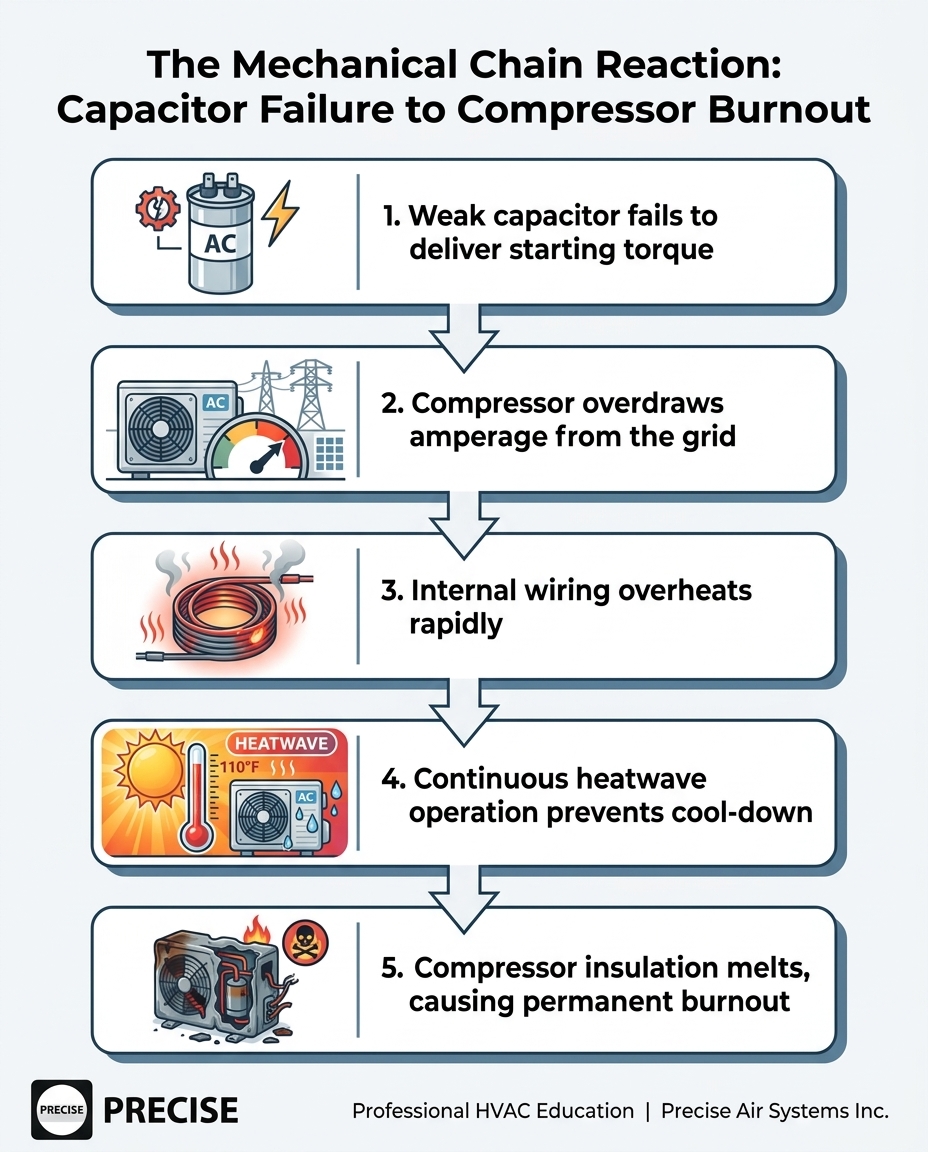
When a capacitor is weak and cannot deliver the stored jolt of electricity, the compressor motor still attempts to start. Because it lacks the local energy reserve, the motor tries to pull the necessary starting amperage directly from the main electrical grid. This is a massive overdraw. The electrical wiring inside the compressor is designed to handle a specific, brief spike in amps, not a sustained, struggling pull from the breaker panel.
The Danger of High Amperage Draw
Amp draw is simply the measurement of the electrical current flowing through a circuit. According to Ohm's Law and the principles of Joule heating, as electrical current increases, the heat generated by that current increases exponentially. When the compressor overdraws amperage because of a weak capacitor, the internal copper windings heat up rapidly.
This extreme electrical overdraw causes the thin layer of protective insulation coating the internal wiring to degrade. If the system continues to try and start without a functioning capacitor, that insulation eventually melts away completely. The bare copper wires touch, creating a permanent, catastrophic electrical short known in the industry as a "burnout." Once a compressor burns out, it cannot be repaired; it must be completely replaced, making it the most expensive repair in residential HVAC.
Why Continuous Heat Cycles Accelerate System Burnout
The urban heat island effect across Los Angeles CA severely exacerbates peak summer cooling loads. Concrete, asphalt, and dense infrastructure trap heat, meaning ambient outdoor temperatures remain high even after the sun goes down. During prolonged 90-degree heatwaves, air conditioning units are forced into near 100% duty cycles just to maintain a livable indoor environment.
This continuous operation is exactly why ignoring a weak capacitor is so dangerous in this specific climate. Under normal weather conditions, an air conditioner runs a cycle, turns off, and allows the internal components to shed heat. During extreme ambient temperatures, those natural cool-down periods are completely eliminated. The compressor is already running incredibly hot due to the constant thermal load of the weather.
When you add the extreme electrical heat generated by a struggling capacitor on top of the environmental heat, the degradation of the internal insulation accelerates drastically. What might take months to burn out during mild spring weather can happen in a matter of days during a severe summer heatwave. The weather turns a slowly failing part into an urgent, immediate threat to your entire system. If you suspect your system is struggling under this thermal load, securing residential AC repair in Los Angeles immediately is the safest way to protect your investment.
Professional Diagnosis: Catching the Problem Before It Escalates
Attempting DIY electrical troubleshooting on an air conditioner is highly dangerous. Capacitors are designed to store massive amounts of high-voltage electricity, and they retain that lethal charge even after the power to the unit has been completely shut off at the breaker panel. Discharging and testing these components requires specialized safety protocols and professional tools.
A licensed technician uses a specialized multimeter to measure the exact microfarad output of the capacitor under load. This precise measurement is the only way to know definitively if the component is failing. More importantly, a professional assessment determines if the issue is isolated to just the capacitor, or if the compressor has already suffered internal damage from high amperage draw.
Precise Air Systems Inc. is committed to fast, reliable local service that catches these failing components before they cause catastrophic compressor failure. We believe in thorough, honest diagnostics. For example, during a recent spring installation of a new Air & Heat unit, our sales representative patiently answered all questions and ensured the setup was completed beautifully with careful customer input on vent placement. We bring that same level of thorough, patient assessment to every diagnostic call. We take the time to measure the amp draw, test the capacitance, and give you a clear, factual breakdown of your system's health, so you can schedule AC service with complete confidence.
Frequently Asked Questions About AC Capacitor Failure
Does a bad capacitor ruin the compressor?
Yes, a bad capacitor is one of the leading causes of premature compressor failure. When the capacitor fails to provide the necessary starting torque, the compressor pulls excess amperage directly from the electrical grid. This overdraw generates severe internal heat, which eventually melts the protective insulation on the motor windings and causes a permanent electrical short.
What happens if you ignore a bad AC capacitor?
If you ignore a bad AC capacitor, your air conditioner will initially suffer from hard starting, frequent tripped breakers, and poor cooling performance. Over a short period of time, the continuous strain of trying to start without the proper voltage boost will overheat the compressor motor, leading to a complete and irreversible mechanical burnout.
Can an AC run with a bad capacitor?
An AC cannot run effectively with a completely dead capacitor, as the compressor will fail to turn on. If the capacitor is only weak (losing its microfarad rating but not totally dead), the system might still manage to run, but it will do so inefficiently. The motors will run dangerously hot, drastically reducing their lifespan and driving up your energy bills.
How long can you run an AC with a weak capacitor?
You should never intentionally run an AC with a weak capacitor. While a system might limp along for a few days or even weeks with a degraded capacitor, every single startup cycle inflicts compounding heat damage on the compressor. During hot summer weather, running a system with a weak capacitor can destroy the compressor in a matter of days.
Why do capacitors fail more frequently during extreme summer heatwaves?
Capacitors are highly sensitive to thermal stress. During extreme summer heatwaves, the ambient outdoor temperature combined with the continuous, non-stop operation of the air conditioner pushes the internal temperature of the capacitor beyond its design limits. This excessive heat breaks down the chemical dielectric fluid inside the capacitor, causing it to bulge, leak, or fail entirely.
Is installing a hard start kit the same as replacing a failing capacitor?
No, a hard start kit and a replacement capacitor serve different purposes. Replacing a failing capacitor simply restores the system to its factory electrical specifications. A hard start kit is an aftermarket addition that includes a heavy-duty capacitor and a potential relay, designed to give an extra massive boost of torque to older, aging compressors that are mechanically tight and struggling to start even with a good factory capacitor.
Secure Your Cooling System Before the Heatwave Peaks
Replacing a weak capacitor is a relatively minor step that prevents a major financial disaster. The mechanics are clear: when your system lacks the stored electrical energy to start properly, it will cannibalize its own compressor to pull the necessary power. Extreme summer temperatures in peak July heat leave absolutely zero margin for error with electrical components.
Do not wait for a strange hum to turn into a silent, broken system. By understanding the mechanical chain reaction of risk versus reward, it becomes obvious that delaying a minor electrical fix is a massive financial gamble. Contact local experts for a fast, reliable assessment of your system's health to ensure your home stays consistently cool and your equipment stays protected all season long.
Customer
Testimonials
Our customers consistently praise the exceptional service and professionalism of our team. They appreciate the honest advice, meticulous work, and the care taken to ensure their satisfaction.

.webp)
Service Areas
